
Event-Driven vs Request-Response: Understanding the Trade-offs
Explore the differences and trade-offs between event-driven and request-response architectures in system design.
In system design, choosing the right architecture is crucial for building scalable and efficient systems. Two common architectural patterns are event-driven and request-response. Each has its own advantages and trade-offs, making them suitable for different types of applications. Understanding these differences can help engineers make informed decisions when designing complex systems.
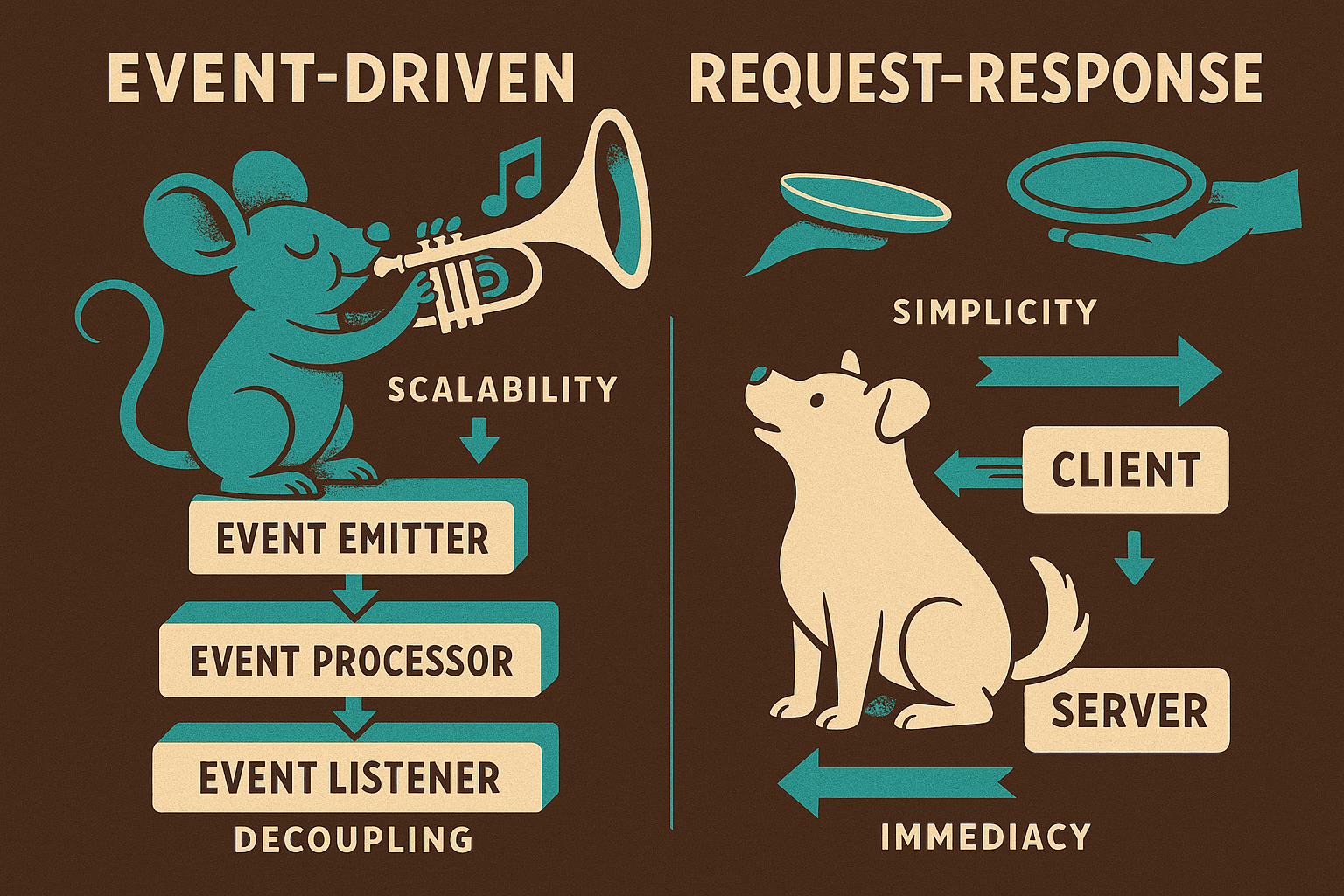
Event-driven architecture is centered around the concept of events, which are changes in state or updates that systems react to. This pattern is highly scalable and decoupled as components communicate through events without needing to know about each other’s existence. It is particularly useful in applications where high availability and real-time processing are critical, such as IoT systems or real-time analytics.
On the other hand, request-response architecture is more synchronous and is based on direct communication between a client and a server. This model is straightforward and easier to implement for applications where immediate feedback is necessary, such as web services or APIs. However, it can become a bottleneck as the system scales, due to its synchronous nature.
The choice between these architectures often depends on the specific requirements of the application. Event-driven systems offer better scalability and decoupling, but can introduce complexity in terms of managing events and ensuring data consistency. Request-response systems offer simplicity and immediate responses, but can face challenges with scalability and potential downtime.
Ultimately, a hybrid approach may be necessary, combining elements of both architectures to leverage the strengths of each while mitigating their weaknesses. This approach allows engineers to build robust systems that can adapt to varying loads and requirements.
Key points
- ·Event-driven is scalable and decoupled.
- ·Request-response offers simplicity and immediacy.
- ·Hybrid approaches leverage strengths of both.
- ·Choice depends on application requirements.
Replies
Sign in to reply.
No replies yet. Be the first to add something useful.