
Measuring AI Hallucination Without Labeled Data
Explore methods to evaluate AI hallucination rates without relying on labeled datasets.
AI models, particularly those used in natural language processing, can sometimes produce outputs that seem plausible but are incorrect or nonsensical. This phenomenon is often referred to as 'hallucination.' Measuring hallucination rates typically involves comparing AI output against a labeled dataset, but this can be challenging when such datasets are unavailable.
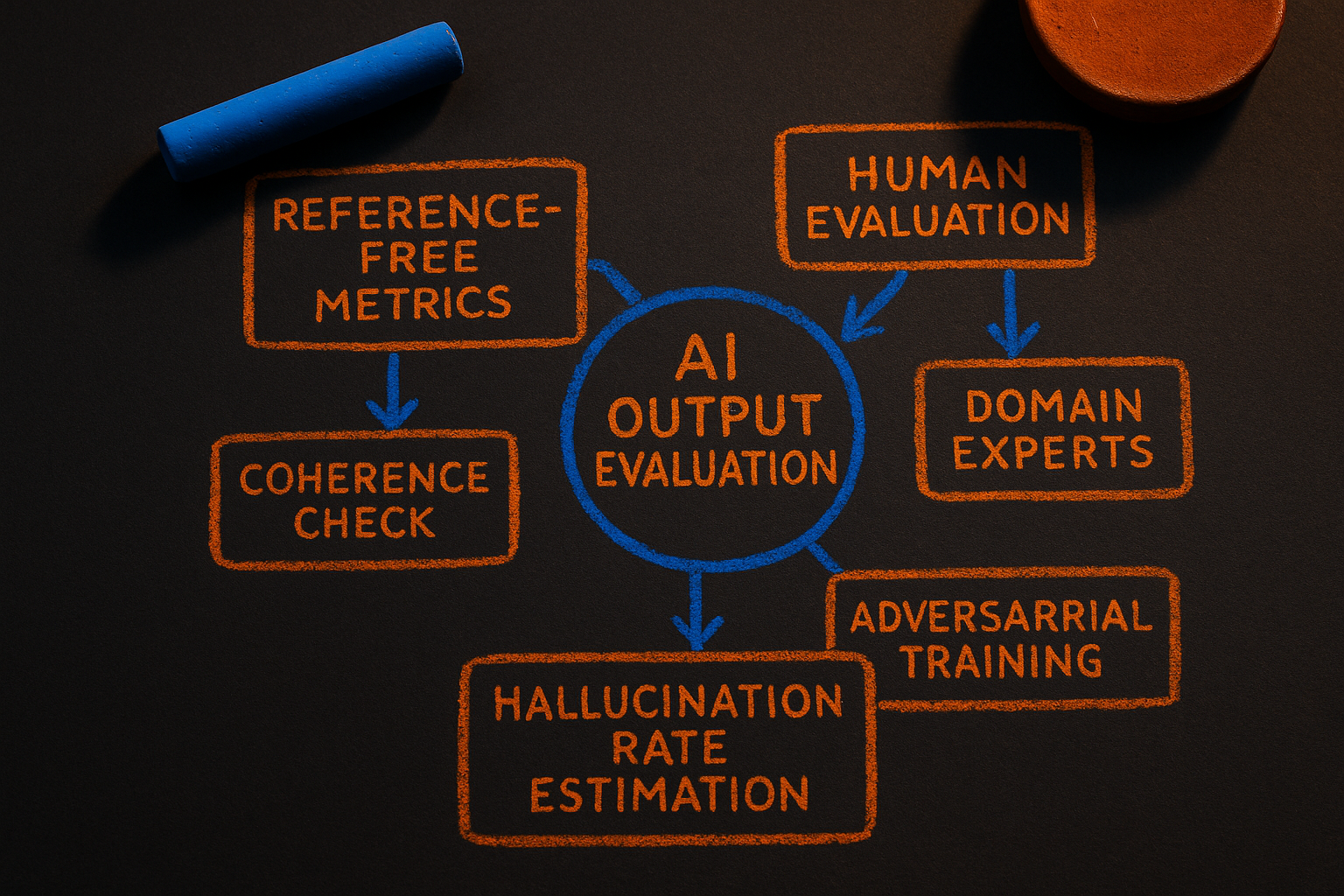
One approach to evaluate hallucination without labeled data is to use reference-free metrics. These metrics assess the coherence, consistency, and fluency of AI-generated text in comparison to a set of criteria or rules derived from domain knowledge. For instance, checking for factual consistency using external knowledge bases or rule-based systems can help identify potential hallucinations.
Another strategy involves using human evaluators to review AI outputs. By employing domain experts or crowdsourcing platforms, organizations can gather qualitative assessments of AI outputs to estimate hallucination rates. This method, while resource-intensive, provides valuable insights into the model's performance in real-world applications.
Reinforcement learning and adversarial training can also play roles in reducing hallucination rates. By continually training models against adversarial examples and feedback loops, AI systems can learn to produce more reliable outputs, even in the absence of labeled datasets.
Key points
- ·AI hallucination lacks labeled data.
- ·Reference-free metrics offer solutions.
- ·Human evaluators provide qualitative insights.
- ·Reinforcement learning reduces hallucination.
Replies
Sign in to reply.
No replies yet. Be the first to add something useful.